Carbon Storage in the Garden: It Starts With Plants
Every plant in your garden is quietly running a carbon capture operation. Through photosynthesis, plants pull CO2 out of the atmosphere and convert it into the physical stuff of life — leaves, roots, wood, flowers, seeds. Some of that carbon is stored for decades. Some of it feeds an underground economy that locks carbon into the soil for centuries. Understanding how this works changes the way you think about what to plant, how to manage your garden, and why it all matters.
This is the first in a series of posts exploring how gardens capture and store carbon. This post focuses on carbon stored in the plant itself. The next will cover what happens below ground, where soil becomes an even larger carbon vault.
How Plants Use Carbon
Photosynthesis — Carbon In
All energy flow in the garden starts with photosynthesis. Plants use light energy to convert CO2 and water into sugar and oxygen. The oxygen is released into the atmosphere. The sugars fuel everything the plant does — growth, reproduction, defense, and maintenance.
Respiration — Carbon Out
Every living cell in a plant — just like every cell in our bodies — burns sugar to power basic maintenance. Under aerobic conditions, sugar + oxygen are converted into usable energy, with CO2 released as a byproduct. If that looks familiar, it's essentially photosynthesis in reverse.
Carbon Balance — Carbon In vs. Carbon Out
Under favorable conditions, plants take in more carbon through photosynthesis than they lose through respiration. This positive carbon balance is what fuels growth, builds energy reserves, and allows the plant to weather stressful periods. In the spring, plants draw down on reserves accumulated the prior year to fuel what is sometimes a year’s worth of growth in just a few weeks. The opposite — a carbon deficit — occurs when respiration exceeds photosynthesis, forcing the plant to draw down its stored energy. Anyone who watched their garden struggle through last summer's heat saw this in action: when temperatures stay high through the night, respiration runs around the clock while photosynthesis shuts down during the hottest part of the day. Plants stop growing and draw down on their reserves just to keep their cells functioning.
Where Do Plants Store Carbon?
Short-Term Storage
Once sugars are produced by photosynthesis, plants use their vascular system to distribute them to storage reservoirs throughout the plant, where they are held as simple sugars or starch until needed. There's a common perception that plants store all their energy in their roots, but the reality is more nuanced. In deciduous trees, branches actually hold about half of total carbohydrate reserves, with the trunk and roots splitting the remainder roughly equally. This distributed storage makes sense — it allows a developing flower or a growing shoot to draw energy from the closest available source rather than pulling it all the way from the roots.
What is remarkable is that plants actively manage where and in what form their energy reserves are stored, shifting resources in response to the seasons and their own needs. In the fall, herbaceous perennials pull energy and nutrients down to their roots and crowns to fuel the following spring's growth. Trees do something similar: before dropping their leaves, they pull valuable nutrients — particularly nitrogen and phosphorus — back into their branches, recovering resources that are metabolically expensive to replace.
Structural Carbon — The Long-Term Vault
Structural carbon is carbon locked into the physical body of the plant — stems, trunks, branches, root systems, and leaves. Most of us have an intuition that trees store more carbon than smaller plants, but the reason why comes down to the chemistry of their cells.
Herbaceous plants build their stems and leaves primarily from thin-walled cells made of cellulose. These cells are relatively quick to build, not particularly carbon-intensive, and decompose readily after the plant dies back. The aboveground portion of an herbaceous plant is essentially rebuilt from scratch each growing season.
Woody plants are fundamentally different. Their aboveground structure — trunk, branches, and bark — persists from year to year. Their real carbon superpower is secondary growth: the ability of each season's shoots to grow outward, thickening and expanding the vascular system. While an herbaceous plant only needs to support a few feet of growth for a single season, a tree needs to be strong enough to support 50 to 100+ feet of structure for decades or centuries.
To meet this demand, woody plants invest heavily in lignin, a carbon-rich compound that reinforces and waterproofs each cell wall. Think of cellulose as the framework of a wall and lignin as the hardening agent that makes it structural. This combination makes wood both strong enough to support the tree's increasing weight and resistant to decay — which is why we use wood as a building material and why wooden structures continue to store carbon for as long as they stand.
The bulk of a tree's trunk is made up of cells that are no longer alive. The water-conducting cells in the xylem and structural fibers die as part of their normal development — their rigid, lignified cell walls are what provide strength and water transport. The older inner wood, called heartwood, is entirely dead tissue: no longer conducting water or storing nutrients, just providing structural support. The outer sapwood still contains some living cells that store carbohydrates, defend against disease, and eventually produce the chemical compounds that create heartwood. But even in sapwood, roughly 90% of the cells are non-living. This is an elegant adaptation: by building its structure primarily from dead, lignified cells, a tree minimizes the ongoing respiratory cost of maintaining its body, freeing more carbon for continued growth.
Below ground, roots undergo a similar pattern of secondary growth, with the larger coarse roots of trees and shrubs being similarly lignified and long-lived. Root systems can represent 20–30% of a tree's total biomass.
Why This Matters for Your Garden
From a design and carbon perspective, this is one of the strongest arguments for including trees and shrubs in every planting. That 100-year-old oak in your backyard has a century's worth of carbon locked in its trunk, branches, and roots. It's a visible, tangible carbon vault — and it's still adding to its stores every year.
This also highlights why removing established trees deserves serious thought. Trees grow slowly and accumulate carbon over decades. Running a mature tree through a wood chipper releases all of that stored carbon back into the atmosphere through decomposition — a decision that takes minutes but can't be reversed for generations. If removing a tree, consider leaving a portion of the trunk standing as a snag - which provides valuable habitat. Additionally, skip the expense of stump grinding (unless you need to replant in the same place) as this preserves the carbon locked up in the root system.
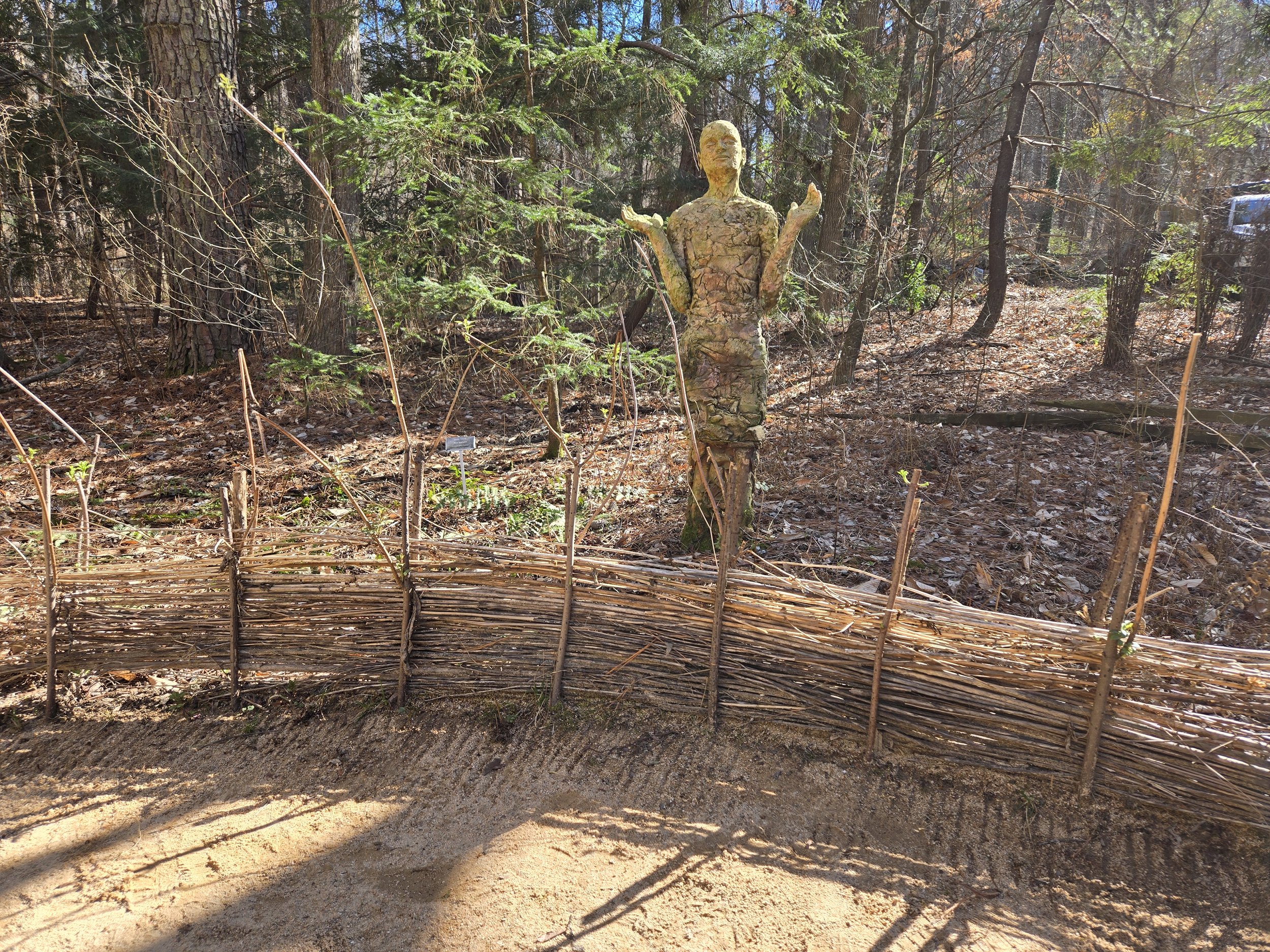
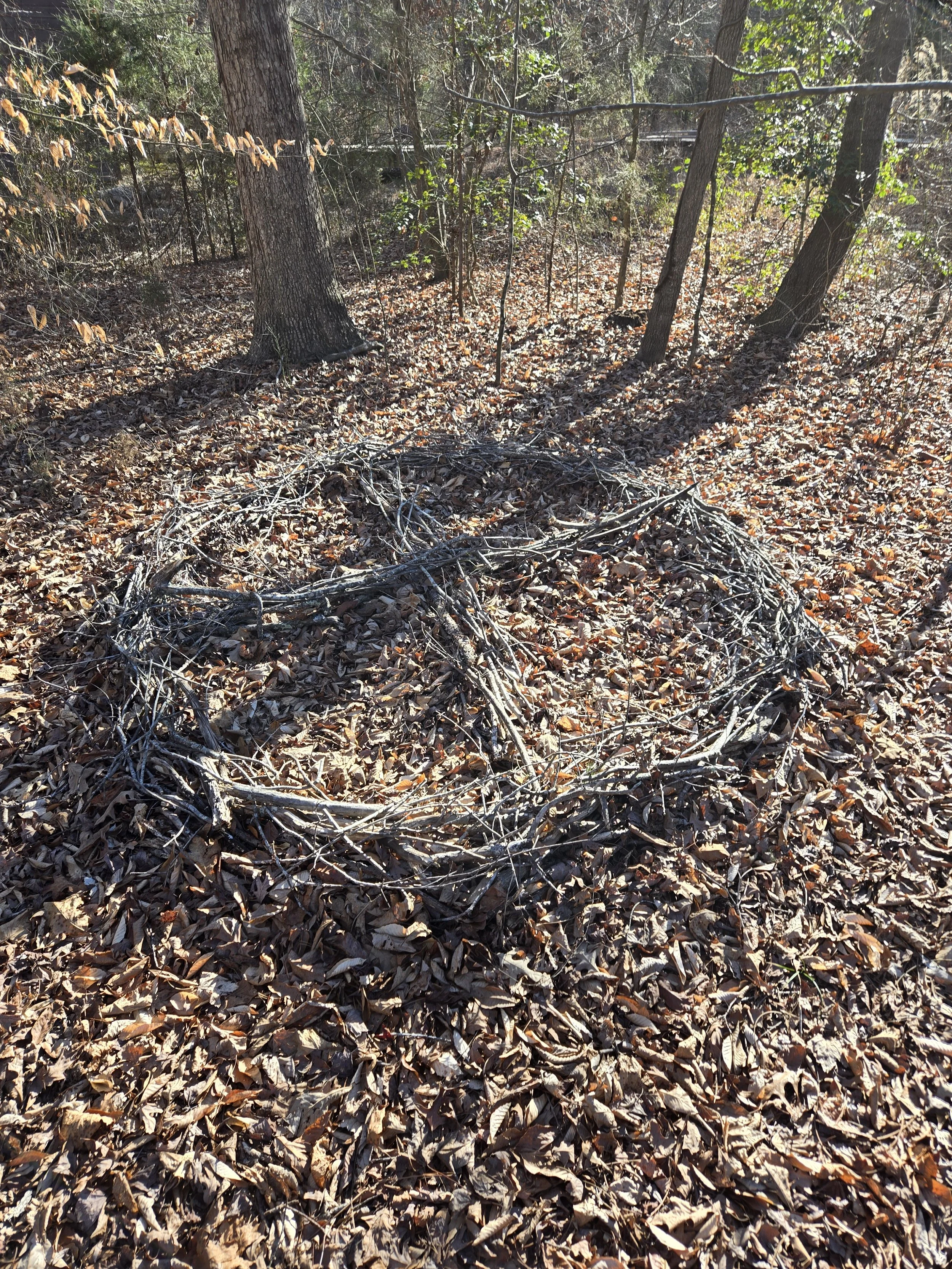
Beyond living trees, this is also an argument to take a light approach when cleaning up fallen branches to delay the release of their carbon. Try to find alternate uses for fallen branches - borders to paths, dead hedge walls, sculpted piles or just left on the ground where they fall.
But this isn't an argument for turning your yard into a pocket forest. As much carbon as that oak has locked in its trunk, there's more stored in the soil beneath it. And the way that carbon gets into the soil — through roots, microorganisms, and decomposition — is a story worth understanding on its own. A garden that combines long-lived woody plants with dense, diverse herbaceous layers is working both carbon storage pathways at once.
We'll cover the soil side of this story in the next post.