Understanding Water Balance: Why Planting Timing Matters
Plant establishment success hinges on one critical factor: consistent soil moisture during the months when roots are actively growing and establishing in their new location. While you can provide supplemental water any time of year, Charlotte's natural seasonal moisture patterns mean strategically choosing when to plant can dramatically reduce the irrigation effort required—and increase your plants' success rate.
In our previous post, we explored how plants biologically prioritize root growth over shoot growth during fall, winter, and early spring. This physiological pattern evolved in response to seasonal environmental conditions. Now let's examine how soil moisture cycles support this biological preference and what it means for your planting decisions.
Understanding Soil Moisture: The Water Balance
Soil moisture follows a predictable annual cycle controlled by the relationship between water inputs and outputs—a relationship ecologists call the water balance.
Soil moisture increases through:
Precipitation (rain or snow) – The primary moisture source, though its seasonal pattern varies by region. Charlotte's Piedmont climate receives precipitation fairly evenly distributed throughout the year. Between 1991 and 2020, Charlotte Douglas Airport averaged 43.6 inches annually with monthly totals ranging from 3.1 to 4.4 inches (NOAA Climate Normals). While rain typically arrives in isolated events rather than steady drizzle, the monthly averages are relatively consistent year-round. Year to year fluctuations between months can be quite large.
Source: NOAA National Centers for Environmental Information, Climate Normals 1991-2020
Absorption from water sources – Lakes, rivers, and streams can supply moisture to adjacent areas, though this is site-specific.
Irrigation – Supplemental water you add when natural precipitation is insufficient.
Soil moisture decreases through:
Transpiration – Evaporation of moisture from plant leaves during photosynthesis. Plants draw water from soil through their root systems and vascular tissues to supply their leaves. This is by far the largest source of soil moisture loss. Large trees can transpire 80-100 gallons of water per day during peak summer growing season, with some wetland species transpiring even more. (Source: Penn State Extension, "How Do Trees Reduce Stormwater and Flooding")
Evaporation – Direct evaporation of water from soil surfaces, primarily controlled by temperature. A 2-4” thick layer of mulch significantly reduces evaporation from soil surfaces.
Drainage – Water percolating downward through the soil profile to recharge groundwater. Drainage rate depends heavily on soil type: sandy soils drain quickly while Charlotte's clay soils retain water and drain slowly.
Runoff – After rainfall, water that isn't absorbed remains on the surface and flows downhill. Runoff increases with slope steepness and on compacted or clay soils that absorb water slowly.
Transpiration and evaporation are typically combined into a single term—evapotranspiration—which captures total water loss from both soil surfaces and plant biomass.
The Seasonal Moisture Cycle in Charlotte
These water balance inputs and outputs combine to create distinct seasonal moisture patterns:
Fall through early spring (roughly October through April): Soil moisture steadily builds. Cool temperatures reduce evaporation rates. Deciduous trees lose their leaves and enter dormancy, eliminating transpiration losses from woody plants. Herbaceous perennials slow their growth and eventually go dormant as well. Meanwhile, precipitation continues through winter. The result: consistently moist soils with minimal irrigation requirements.
Late spring through summer (roughly May through September): The pattern reverses once trees leaf out in spring. Transpiration water loss increases as leaves emerge. As temperatures climb and days lengthen, both evaporation and transpiration accelerate. Total evapotranspiration demand peaks in mid-summer when long days, high temperatures, and full tree canopies combine. Even though Charlotte continues receiving 3-4 inches of rain monthly, evapotranspiration exceeds precipitation during this period, drawing down soil moisture between rain events.
Fall (September-October): The cycle begins again as temperatures cool, days shorten, and deciduous trees shed leaves. Transpiration losses decline and soil moisture begins recharging even as precipitation rates remain similar to summer levels.
The water balance diagram below illustrates this annual cycle. While created for Chico, California, the NC Piedmont follows similar patterns: soil moisture builds from October through April (Recharge/Surplus), then depletes from May through September (Utilization) as temperatures rise and trees transpire actively. Charlotte typically stays in the "Utilization" phase through summer but can shift into "Deficit" during droughts or extended dry spells when soil moisture is fully depleted.
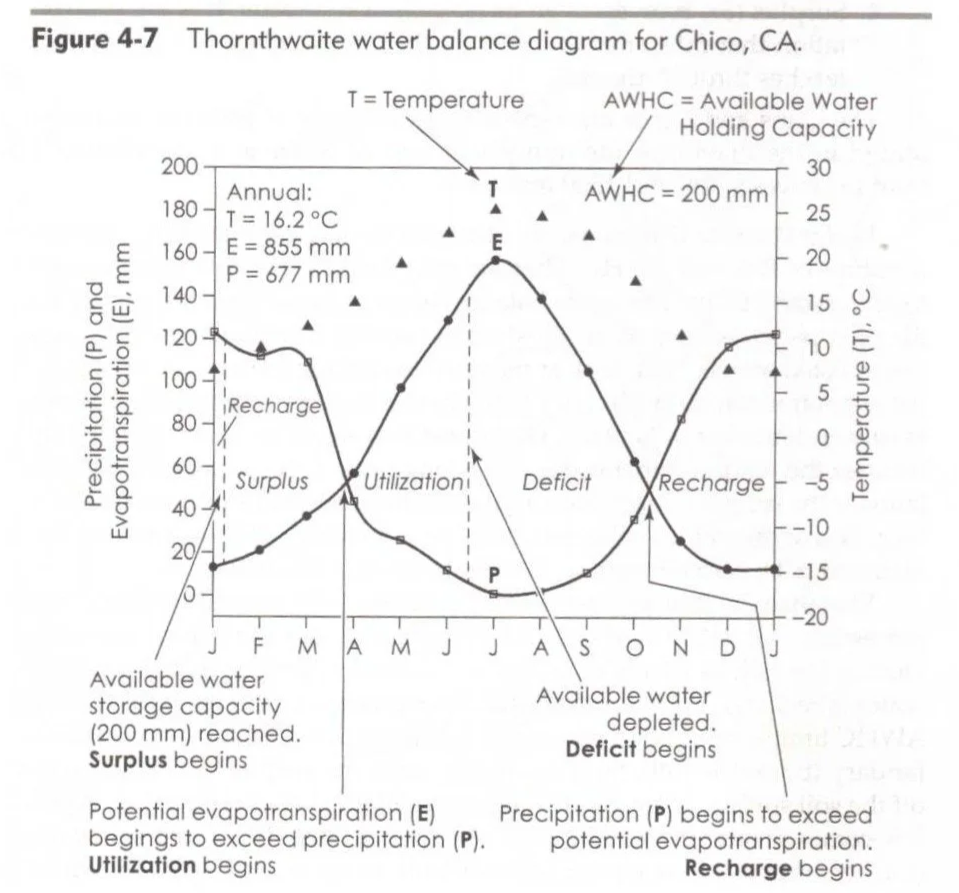
Source: Soil Science Simplified, 5th Edition. Donald Franzmeier, William McFee, John Graveel, Helmut Kohnke
What This Means for Your Planting Decisions
As gardeners, we want our plants to thrive with minimal intervention. Since consistent soil moisture is critical to reducing stress during plant establishment, we need either naturally moist soils during the establishment period or we need to provide a steady stream of supplemental irrigation.
The most efficient approach: plant during the natural moisture surplus period.
Fall/winter planting (October through March) aligns with Charlotte's recharge/surplus period when soils are naturally moist. Plants installed during this window typically need relatively little watering, decreasing the closer you get to winter. By the time the utilization period arrives in late spring, root systems have had 4-8 months to establish, making plants significantly more resilient to summer stress.
Spring planting (April through late May) captures the tail end of the surplus period before transitioning into the utilization phase as trees leaf out and temperatures rise. Moisture levels are still positive, but plants are in a race to establish their root systems before soil moisture becomes limiting, and success depends on committed monitoring and consistent supplemental watering throughout the first summer.
Summer planting (June through August) works against the natural moisture cycle and presents the most challenging conditions: peak evapotranspiration demand, regularly depleted soil moisture, and heat stress. This is why we generally don't recommend summer plantings for all but the most dedicated gardeners. While possible with diligent attention, summer planting carries higher risk and demands the most irrigation and monitoring.
When you combine these seasonal moisture patterns with plants' biological preference for fall/winter/early spring root growth (discussed in our previous post), the advantages of fall through early spring planting become clear.
Finding the Right Balance for Your Situation
Understanding these moisture cycles doesn't mean you should only plant in the fall. Often spring installation is necessary or preferable—that is when you have time for the project, your landscaper's schedule permits it, many native plants have much better availability / are in better condition later in the spring (i.e. Joe Pye Weed), or you're predominantly working with warm-season species that prefer spring planting (i.e. Muhly grass, Little Bluestem).
For spring installation, understand what's required for success:
Commit to monitoring soil moisture at least twice weekly through the first summer, starting when the trees leaf out.
Water deeply and consistently when soil becomes dry (see our [planting care instructions] for specific protocols)
Choose smaller plant sizes (plugs, pints, quarts) when possible—they establish more quickly with less top growth to support. If you need to install 1g size plants, look for the runts with a robust root system.
Irrigation strategy like as sprinkler with timer, soaker hoses, drip systems, or tree watering bags/diapers to make consistent deep watering more manageable
Additionally, if you are looking at a large project or have less risk tolerance/time for monitoring, consider splitting your installation between spring and fall, doing one section in the spring / the rest in the fall or doing warm season flowers/perennials in the spring and cool season perennials/trees/shrubs in the fall. This gives you a smaller area/fewer plants to focus on for monitoring and care during the first summer and allows you to incorporate lessons learned from the first part into the fall planting.
The key is making informed decisions based on your capacity for plant care, plant availability, contractor scheduling, and your risk tolerance. Fall/winter planting works with natural moisture cycles to minimize inputs and maximize success rates. Spring planting can work well but requires greater commitment to supplemental care during establishment. Understanding these dynamics helps you choose the timing that best fits your situation and gives your plants the best chance to thrive.