The Other Carbon Story: Why Soil Matters as Much as the Plants Above It
This is the second in a series on carbon and the garden. The first post covered how plants use and store carbon in their own tissue. This one focuses on the soil — which turns out to be the larger of the two carbon vaults.
In the first post in this series, we traced the path of carbon from the atmosphere into the physical structure of plants — the sugars, the cellulose, the lignin-rich wood that makes a tree trunk both strong and carbon-dense. But as impressive as a mature tree is as a carbon vault, it's actually the soil beneath it that holds more. Roughly 60% of the carbon stored in a landscape is underground. More importantly, carbon stored in the soil tends to stay stored — stable for centuries or millennia rather than decades. Knowing how that happens, and what undoes it, changes the way you think about managing a garden.
Two Forms of Soil Carbon
Soil carbon isn't one thing. It exists on a spectrum from coarse, recently fallen material — a recognizable leaf, a chunk of decomposing root — to microscopic particles chemically bonded to individual clay and silt particles in a way that makes them essentially immovable. Scientists call these two ends of the spectrum Particulate Organic Matter (POM) and Mineral Associated Organic Matter (MAOM).
POM is the active fraction — relatively new, still being processed, protected mainly by being buried in the soil rather than exposed at the surface. MAOM is the stable fraction. At this scale, individual carbon molecules are physically tucked inside soil aggregates — clusters of particles bound together partly by the living and dead bodies of bacteria, whose cell walls are coated in sticky compounds that act like a biological glue. Carbon is also directly bonded to the mineral surfaces within these aggregates with a strength comparable to a strong magnet. Carbon in this form isn't going anywhere without significant disturbance.
How Carbon Gets Into the Soil
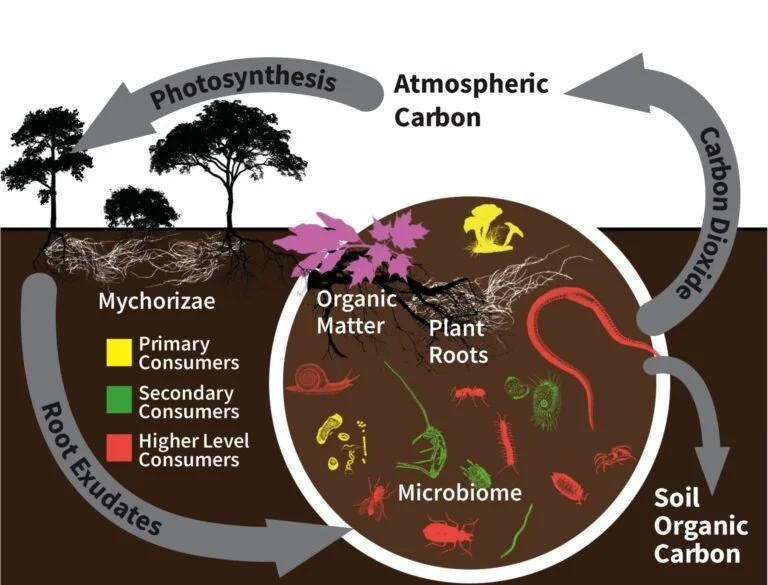
Atmospheric carbon enters through photosynthesis and reaches the soil via two pathways: root exudates secreted directly into the root zone, and organic matter deposited on the surface and broken down by a layered community of organisms. Mycorrhizal fungi (left) form direct partnerships with plant roots and provide a separate, faster carbon pathway into stable soil organic carbon. Note the trophic layers within the soil community — primary consumers (yellow) feed on organic matter and root exudates directly, secondary consumers (green) feed on primary consumers, and higher-level consumers (red) feed on those below them. At each level, organisms incorporate carbon into their bodies, and when they die, that carbon re-enters the soil. Image by Regenerative Design Group.
Carbon reaches the stable MAOM stage via two pathways — one slow and indirect, one fast and direct.
Litter decomposition is the pathway most people picture when they think about organic matter entering the soil. A leaf falls, it's colonized by fungi, broken into fragments by beetles and earthworms, processed further by bacteria, and eventually what remains is fine enough to bond to soil particles. Fungi are the primary decomposers of lignin-rich woody material — they have the enzymatic tools to break down the tough stuff. Softer, nitrogen-rich material gets processed more readily by bacteria. At each stage, organisms incorporate some carbon into their own bodies, which means that when those organisms die, their remains also enter the decomposition cycle. Carbon is being recycled through multiple generations of organisms, each pass making what remains smaller and more chemically stable. These organisms also play a transport role, physically moving carbon deeper into the soil as they go: earthworms ingest surface material and deposit it deeper as they move through the soil; fungi do something similar at a finer scale, decomposing woody material and transporting nutrients through their thread-like hyphal networks, sometimes meters from where decomposition began.
Root exudation is the second pathway and in many ways the more interesting one. Living roots continuously release a mix of sugars, amino acids, and enzymes into the soil immediately surrounding them. Plants do this deliberately, feeding the bacteria and fungi that live in the root zone in exchange for nutrients and water those organisms can access. The relationship is so central to plant nutrition that research estimates put exudate-specific allocation at roughly 5–20% of net photosynthate, with total below-ground carbon allocation — including root turnover and sloughed cells — running higher.
What makes this pathway so valuable for soil carbon is its efficiency. Root exudates are already simple molecules. They don't need years of decomposition before they can bind to soil particles — microorganisms process them quickly, and the resulting compounds can enter the stable MAOM fraction much sooner than litter-derived carbon. This is one key advantage of a densely planted garden over bare soil covered with mulch. Mulch is beneficial — it protects against erosion, feeds soil organisms, and slowly contributes organic matter. But it can't replicate what living roots do continuously throughout the growing season.
How Carbon Gets Released
The main mechanism for releasing soil carbon is disturbance — specifically, anything that breaks open the aggregates where carbon is stored and introduces oxygen to soil that has been largely oxygen-poor. Tillage is the clearest example. When you turn over soil, you physically pulverize the aggregates that protect MAOM and destroy the hyphal networks that mycorrhizal fungi spend the season building — both of which take years to reestablish. Breaking open those aggregates exposes previously protected organic matter and introduces oxygen to parts of the soil that have been largely oxygen-poor. With both fuel and oxygen now available, decomposers that had been operating slowly accelerate dramatically, burning through stored carbon and releasing CO2. This is what happened to the prairie soils of the Midwest over decades of agricultural tillage — soils that had accumulated carbon for thousands of years lost a significant fraction of it within decades of being plowed.
Erosion is the other mechanism. When fast-moving water strips away topsoil, it removes the surface layer where organic matter concentration is highest — years of biological activity carried off in a single heavy rain. Protecting bare soil with mulch or plants is partly about this.
What This Means for Your Garden
The practical implications follow pretty directly from the science.
More plants, more carbon. The amount of carbon entering the system is proportional to the biomass above and below ground. More plants means more root exudates entering the fast pathway, more litter feeding the decomposition chain, and a more active microbial community to process both. Filling in gaps rather than leaving bare soil — even temporarily — matters.
Diversity outperforms monoculture. A mix of plant species active at different times of year keeps carbon flowing into the soil more consistently. Different species also support different microbial communities, which is part of why diverse plantings tend to have richer, more biologically active soil than monocultures. Including plants with deep root systems extends carbon storage into deeper soil horizons where it's much less susceptible to disturbance. Little bluestem, a native prairie grass well-suited to Piedmont gardens, has documented root depths of 5 to 8 feet — an underground carbon investment that conventional lawn grasses can't match.
Minimize soil disturbance. This is why we use a broadfork rather than a tiller when preparing new beds — it loosens compaction and lets us work in compost without inverting the soil profile or destroying the aggregate structure that took years to form. When adding organic matter to an existing bed, simple top-dressing — spreading a 1–2" layer of compost on the surface and letting earthworms and other soil organisms work it down — achieves the goal with even less disruption. For the same reason, cutting weeds off at the soil surface and leaving the roots to decompose in place is worth the extra patience compared to pulling them out with soil attached.
Leave organic matter on site. Every time plant debris gets bagged and carted away, you're removing the feedstock that would have fed your soil's microbial community. Leaving it to decompose where it falls, or gathering it into a brush pile or compost area nearby, keeps that carbon cycle running on site.
The Larger Picture
The soil organic matter that accumulates under a healthy, diverse planting took years to build. It can be degraded much faster than it was created. Managing a garden in a way that builds and protects that resource isn't a sacrifice — richer organic matter improves water-holding capacity, nutrient availability, and soil structure all at once. The garden that's best for the soil is generally the most resilient garden.
The next post in this series will look at the other side of the ledger: where conventional landscape maintenance releases carbon — and what lower-impact alternatives look like.